


Probably the most striking part of the Devil’s Wall is located south of Weddersleben and stretches as far as Warnstedt. There, the Königstein, the Mittelsteine and the Papensteine are lined up over a length of two kilometers.
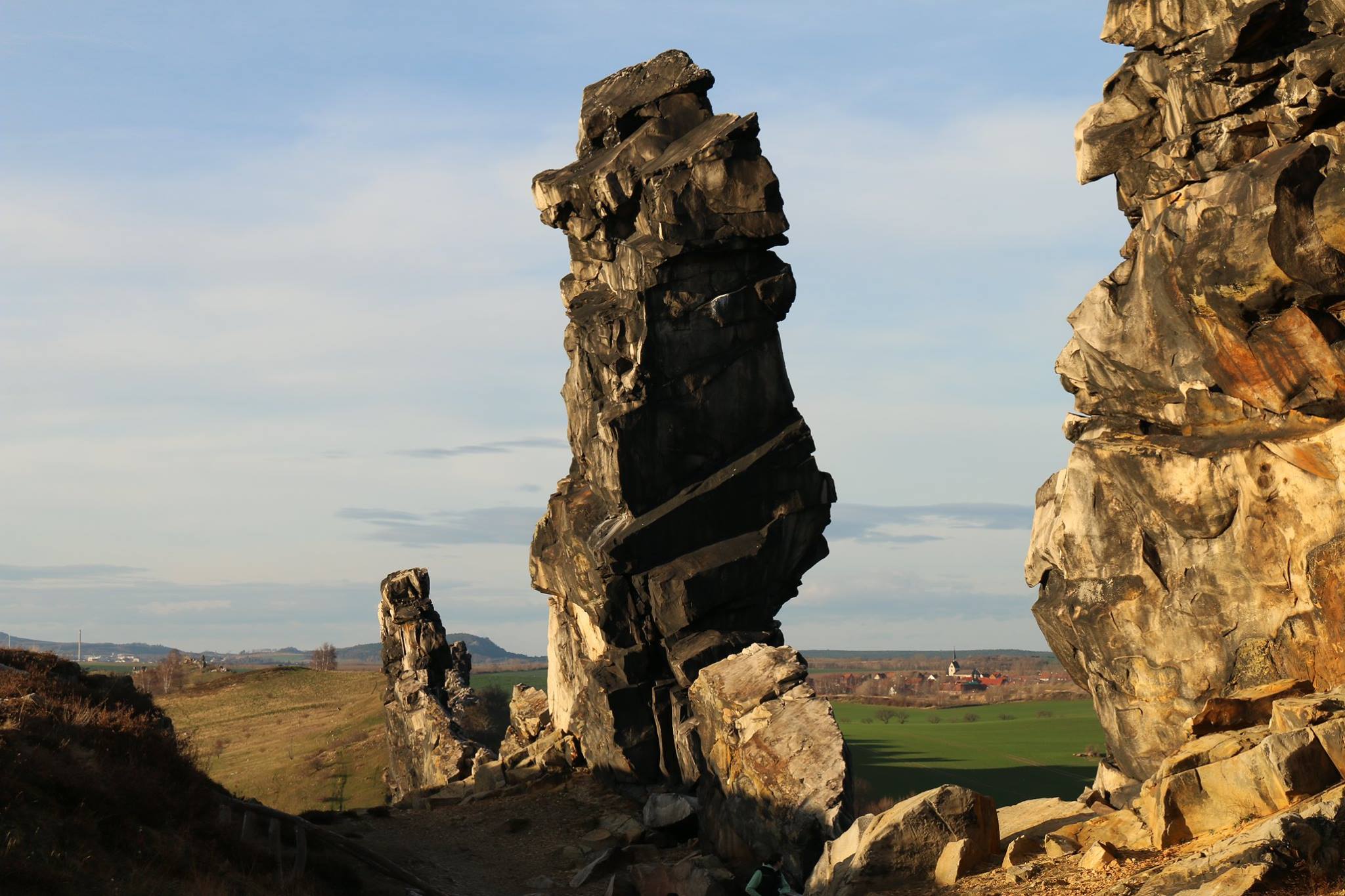
The Teufelsmauer is a rock formation consisting of hard sandstones from the Upper Cretaceous in the northern Harz foreland. It comes to light in three places over a length of 20 kilometers between Ballenstedt in the southeast and Blankenburg in the northwest. It begins with the Gegensteine northwest of Ballenstedt and ends between Timmenrode and Blankenburg with the Hamburg coat of arms, the Heidelberg and the Grandfather and Grandmother cliffs.
Due to its unusual shape, many legends and myths have grown up around the bizarre chain of rocks. Fascinated by the geology of the Teufelsmauer, Goethe also visited the legendary sandstone wall in 1784.
The legend of the Devil’s Wall
It is said that the devil once suggested to the Lord God that the world should be divided up between them. To this end, the devil wanted to build a great wall to separate the two realms. The Lord God agreed, but made it a condition that he had to complete it in one night by the first cockcrow.
A farmer’s wife, who wanted to sell her rooster at the market, passed by the place where the devil was doing his work one night. When she saw him, she was frightened, stumbled and the cock began to crow. The devil then thought he hadn’t made it and destroyed the almost finished wall.
From the „Teufelsmauer“ parking lot between Neinstedt and Warnstedt, a signposted path leads along the Bode and on to the stamping point.
The Devil’s Wall Trail leads from west to east past the towns of Blankenburg, Timmenrode, Warnstedt, Thale, Weddersleben, Neinstedt, Bad Suderode, Gernrode, Rieder and Ballenstedt, touching all the striking rock formations of the Devil’s Wall along the way.
