


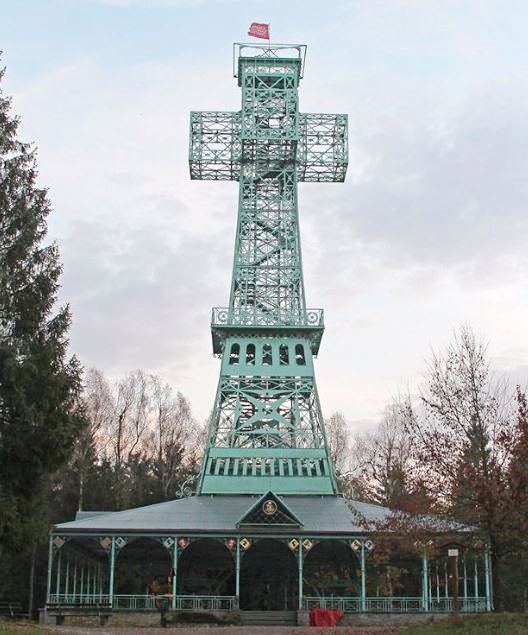
On the „Josephshöhe“, the southern summit of the Großer Auerberg (580 m above sea level), today’s 38 m high Joseph’s Cross was erected in 1896 as a steel truss construction.
A wooden half-timbered lookout tower stood on the Auerberg as early as the 17th century, but had to be demolished in the 18th century due to dilapidation.
In 1832, Count Joseph zu Stolberg-Stolberg commissioned the famous Berlin architect Karl Friedrich Schinkel to design a new tower. Schinkel designed a wooden tower in the form of a double cross, which was ceremonially inaugurated in 1834 and named „Joseph’s Cross“ after its commissioner. The tower had no stairs and could only be climbed using ladders. In June 1880, the structure was so badly damaged in a thunderstorm that it was demolished.
The desire to rebuild the Joseph’s Cross found a fervent supporter in the Harzklubzweigverein Stolberg, which was founded in 1886. In 1896, construction of the new Joseph’s Cross began and reference was made to the double cross shape designed by Schinkel. However, the tower was modeled on the Eiffel Tower in Paris as a steel lattice construction and components of the Eiffel Tower, such as the round arch between the legs, were even copied. The costs of 50,000 marks were shared by the Princely House of Stolberg and the Harzklub Zweigverein Stolberg.
After extensive renovations during the reunification period and in 2003, you can enjoy a magnificent view over the Harz Mountains and across to the Kyffhäuser from the viewing platform, which can be reached via 200 steps.
From the parking lot at the foot of the Auerberg, you can hike up to the Josephskreuz via the signposted hiking trails. From the Schindelbruch nature resort, the „Road of Songs“, with 16 text panels of German folk songs, leads up to Josephshöhe.
